
Somewhere Else to Go
Or why I’m still speaking about complaining

I am in the middle of a book tour for No is Not a Lonely Utterance. I am so grateful to everyone who has come along thus far.
In my introduction to the book, I acknowledge that I wrote it in an increasingly hostile environment. More and more messages are being sent out that say to some people: you do not belong here, you have taken what is ours.
I put it this way,
I have been writing whilst those of us who use the word queer to describe ourselves or our projects are called groomers and paedophiles. I have been writing whilst many people in government and the media have been campaigning to dismantle the rights of trans people, with report after report, article after article, representing trans people as dangerous and deluded. I have been writing whilst politicians describe the reform of the welfare system to make it harder to access benefits as “a moral mission,” labelling those who need benefits, including disabled people, the poor and the unemployed, fraudsters. I have been writing whilst Israel has been conducting a genocide in Gaza and when those of us who have protested that genocide, and who are fighting for a free Palestine, are labelled extremists.
I highlighted words from groomers to extremists because of how they stick, to whom they stick. And if I wrote the book in an increasingly hostile environment, we are now meeting in an increasingly hostile environment. That is why it is all the more precious to meet, a meeting can be a breathing space, helping us to hold on, to go on, in the face of so much violence.
In a previous note, I mentioned my gratitude to Round Table Books for the warmth of the opening event, spilling out as we did into a busy arcade in Brixton. I also thanked my complaint collective for sharing many profound reflections on the painstaking labour of complaint at The Feminist Library. In the events we have had since – hosted by Foyles, Queer Emporium, Small City Bookshop and Heffers - I have been in conversation with feminist of colour scholar-activists, Heidi Safia Mirza, Durre Shahwar, Noreen Masud, and Mónica G. Moreno Figueroa. What a privilege to be in conversation with you all! I was so lucky to be asked such thoughtful questions, crafted with care.
I’ve loved seeing photos of the tour on Instagram. It was extra special to travel to some of these events with my partner Sarah Franklin, and our delightful furry companions, Poppy and Bluebell. Just a heads up for those coming to launches in Dublin, Edinburgh, Glasgow, Nottingham, Sheffield and Manchester: Poppy and Bluebell will not be there. Sorry! Here’s a photo of me and Heidi with Poppy and Bluebell.
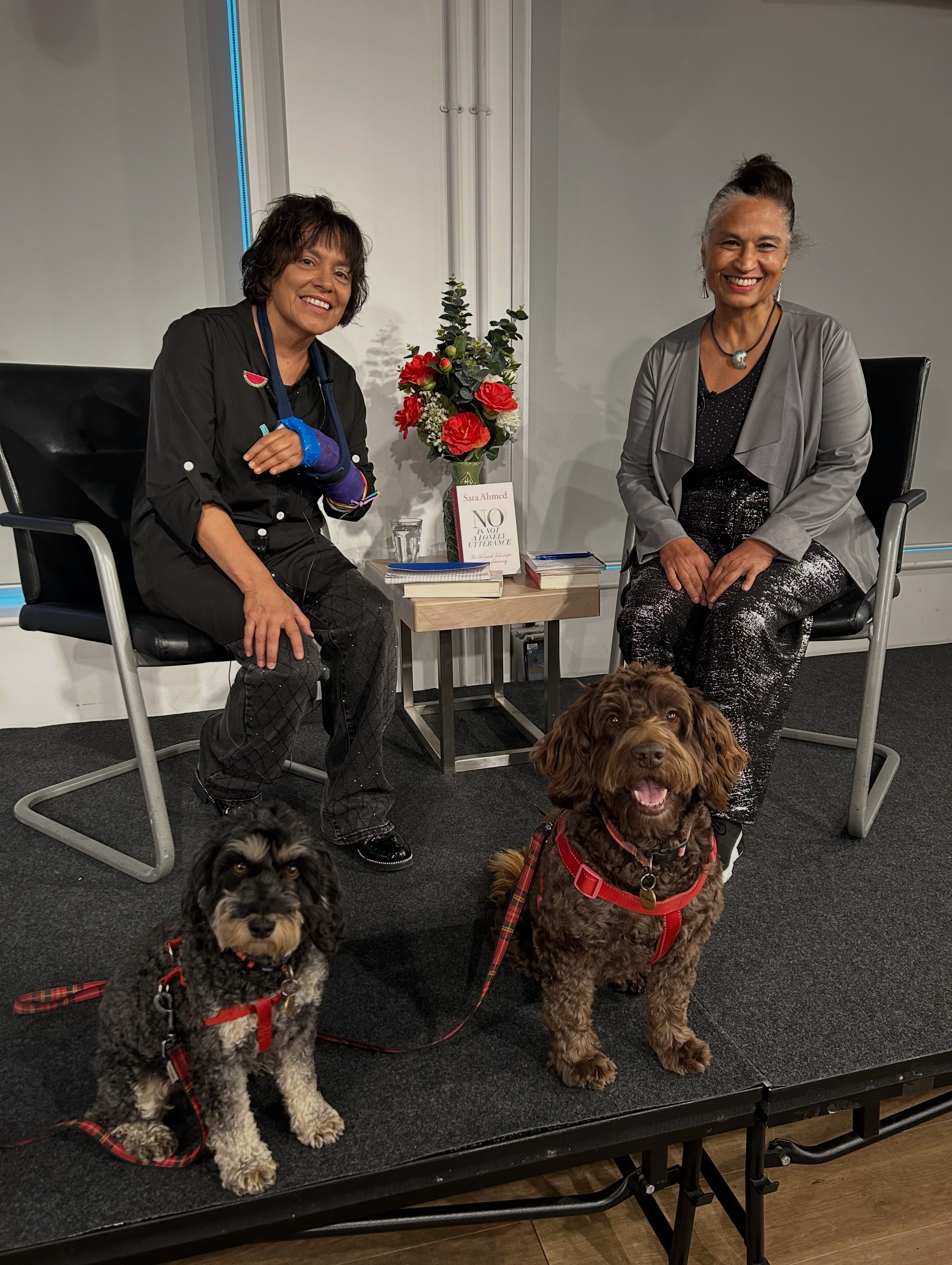
If you are not on social media and would like to share photos from any tour events, please do send them to complaintstudy@gmail.com. I might make a tour album later.
The book tour is in effect the publicity for the book, a way of creating a small but lively public around it. Why highlight the? Despite valiant efforts from our publicity team, there have been no reviews of the book in the mainstream media nor any mainstream engagement with the work itself. This will probably not surprise most readers of this newsletter, and it certainly hasn’t surprised me. There has only been one review of my work in a mainstream newspaper in the UK, a review of The Feminist Killjoy Handbook by a “gender critical” feminist. This is how The Times represented its reviewer’s characterisation of my book:
“A feminist book by an author who’s forgotten what a woman is.”
This statement, even if rather amusing, is telling. Consider the killjoy equation offered in the handbook:
White feminism = blanking
The review itself was an object lesson in forgetfulness including the forgetting of feminist critiques of “what a woman is.” I summarised some of my own critiques of “gender critical” feminism in this newsletter under that same heading, blanking.
There was a long delay in getting No is Not a Lonely Utterance out because I had to make some changes very late in the day to deal with concerns raised by lawyers about the risk of defamation. In order to keep the scheduled launch date, we had to skip one of the steps in the usual publication process: collecting endorsements. The book still does not have any endorsements; we did not want to ask people to give up time to write them given the book is already out.
As the book was not supported by endorsements, I decided I needed to be open to other ways of promoting it. I agreed to write a piece about it for a mainstream newspaper or at least to pitch one. I was going to return to what happened when I resigned from my post. I was going to describe how my resignation got picked up by the mainstream media and turned into a sex scandal. This is not uncommon: complaints often come into the public realm by being turned into scandals.
Behind many scandals are unheard complaints.
I was going to explain that I refused all invitations to speak on television and the radio at the time because I did not want to turn the students’ complaints into my platform. I was going to explain why becoming a feminist ear, listening to other people’s complaints, was thus a political decision. I was told that they were “interested” in the piece but that the editor had asked, “Would she tell us how to complain well? Which would be good!”
No!
That’s what I wanted to write back.
That would not be good!
When you complain not just within institutions but about them, you are typically told the problem is not just that you complained but how you complained. You might be told your complaint is too eloquent or not eloquent enough, too emotional or not emotional enough.
That solution is the problem in new form.
To locate a problem is to become the location of a problem.
I sat with that no for some time. But I was encouraged to try again given that sharing the work in this paper could help me reach so many more readers. So I wrote a new pitch about how complaints are not heard mostly because of who makes them (in the book I do talk about Karen and other well-heard racist complainers). For some people, having their complaints heard would mean changing the conditions in which they live or work. Unheard complaints means unchanged conditions.
I entitled this possible-piece-to-be, “Unheard Complaints.” It took some time before they came back to us. It was a no, “they don’t feel it’s a feature piece.”
Perhaps the more you locate the problem in the system rather than in those who complain about the system, the less likely your piece will feature. Of course, I am telling the story from my point of view. And the point of telling the story is not to complain. The point is the consequences.
To get some kinds of work out, we have to create our own paths. A destination can be a deviation, like the desire lines I wrote about in Queer Phenomenology, lines on the ground created from people not following the official routes.
Word of mouth. Independent bookstores. Queer spaces. Feminist libraries. Also queer podcasts: thanks to Queer Lit, there is a podcast entitled No!
No, and so:
We create our own communication networks.
We give ourselves somewhere else to go.
That’s how I understand a feminist ear:
Giving complaints somewhere else to go.
In our conversation, Heidi Mirza asked me how I protected myself given I listened to so many complaints that were so full of pain and trauma. I said what came to mind. That’s usually how I answer questions: I say what comes to mind, then work my way to an answer by trying to work out that relevance of that initial thought to the question! I answered that I had been helped by listening to other people’s stories of complaint. I felt less alone. Talking to other people who had gone through a complaint process, helped me to process the trauma of what had happened to us. It helped me to understand better what had happened.
I realise now I didn’t really answer Heidi’s question; I didn’t loop back to it. So I will do that now.
Listening as a feminist ear is not just about taking something in but getting it out.
One person wrote to me that she wanted her complaint “to go somewhere other than round and round in my head.” Round and round in my head: it’s a lot of movement not to get very far. So much movement, so much time, so little room left for anything else in our heads.
Time can be room.
To give your story to someone else means it goes somewhere else. That’s why even if telling the story takes time, telling it can give you room.
That’s another reason it mattered that I’d left an institution. It meant that the complaint was being heard not just by someone else but from somewhere else.
It helped to be somewhere else.
It’s the “somewhere else to go” that answers Heidi’s important question. We know some versions of self-protection are about sealing ourselves off from what threatens or endangers our well-being. That’s the conservative version of happiness that Audre Lorde critiqued so powerfully in The Cancer Journals. Anyone involved in a struggle against injustices needs to be open to being affected by other people’s suffering. You also need to hold on, hold yourself together, so you can keep doing the work.
Protection is not about burying our own pain or other people’s. It is about finding different ways to give it expression.
Yes, to give our complaints somewhere else to go.
And that’s what I meant when I said I didn’t want to become another filing cabinet.
Keeping writing and speaking of complaints was how I kept going.
Not a seal but a leak.
To communicate as to seep.
I think of a conversation I had with Laura, a Black woman, about survival. She said, “In order to survive in a hostile environment, you have to do this work of institutional analysis all the time. They are going to do this, and I have to do that, and then I do this, and they do that: you know what I mean? It’s constant, this watchfulness that you have to have in order to protect yourself from being really knocked.”
To protect yourself is not to protect yourself from what you know.
To protect yourself is to protect yourself because of what you know.
Thanks so much Pratibha- I have just started reading and am loving your new book! Hopefully we can catch up soon xx
Thank you Sara. Your writing always moves me. I feel the truth of it seeping into my skin.