

“In nature, nothing is ever perfectly clear”
Simone de Beauvoir
**************************************************************************************************
On the weekend I read the EHRC’s “interim update,” which they posted on Friday night in response to the judgement by the Supreme Court.
It felt like entering a feminist dystopia.
I was entering a feminist dystopia.
Feminist dystopias, as nightmare visions of the future, tend to teach us about the past and how it endures in the present. They tell us about time. As Sophie Gilbert describes, “it’s never felt more obvious that something is very wrong with the shape and trajectory of the world, that time itself is out of joint.”
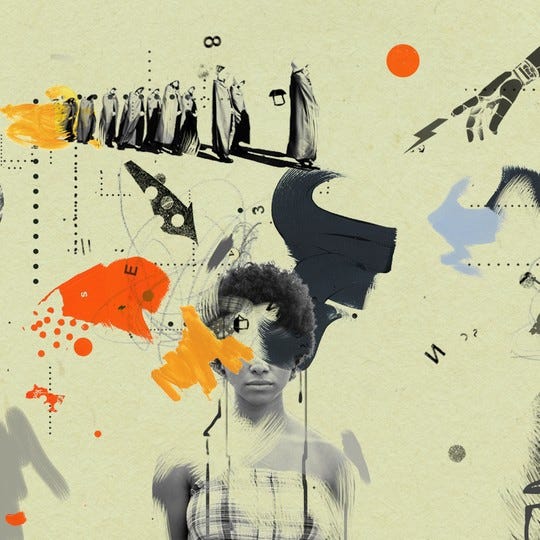
The EHRC, time out of joint. In their “interim update,” the language of biological women and biological men is turned from statutory interpretation into a technology, telling us what we “should” do, where we “should” go, in organising or using single sex facilities.
Or perhaps there was not much turning involved.
Only biological women to enter the women’s toilets! But even if trans men are biological women, not them!
Only cis women to enter the women’s toilets!
Though, of course, they made that instruction without using the adjective cis; keeping the unmarked, unmarked.
I visited X briefly. And what I saw was happening there is obviously what will happen now even more or all the more. A barrage of hatred directed against trans people just for existing or for persisting in living their lives on their own terms and against anyone who spoke out in support of trans people’s right to do so.
The Supreme Court judgement has given that harassment a green light.
On X, I also observed another phenomenon I called in The Feminist Killjoy Handbook, “the minimisation of harm.” Many “gender critical” feminists suggested that were gender-non confirming women to be questioned about their right to use facilities for women, then that would be no big deal, not really “harassment,” because they can just say they are women, and then pee in private.
Pee in private, be in private.
Out-of-jail-free-card and into-the-toilet-card.
For gender non conforming biological women only!
The implication is, of course, that if a trans woman was questioned, then the questioner would be right (as well as have the right) and she should just exit the room. And then it could be assumed that if a trans woman doesn’t exit, if she insists on her right to be or to pee, and is harmed or harassed, she was the cause of it.
The violence and injustice of that scenario should not be underestimated.
Transmisogyny: a history of harm.
How trans women are treated as causing the harassment directed toward them.
Whilst being deprived of privacy. That human right.
And also, whomever is being questioned, these questions, so often repeated, made more forceful if you do not comply by withdrawing from the situation, mostly do not come from a gentle sweet place.
Perhaps they imagine the scenario thus.
“Hey, this is the women’s room! Or you are a woman, sorry, silly me, my mistake.”
Questions often take the form of a hostile demand that some people reveal themselves, explain themselves, justify where they are or who they are. I call this a killjoy truth.
For some to be is to be in question.
I first learnt what it meant to be misgendered from my girlfriend many years ago. Like me, she is cis. Unlike me, she is gender non-conforming. She kept being misgendered, especially when we travelling together: “what can I get you sir, oh sorry, madam.”
Mostly she got out of the situations she ended up in, sometimes with humour.
But still the repetition was wearing.
You can end up feeling surrounded. Because you are surrounded.
When hostility comes out, it was already there.
One time a group of kids on bikes rode up to us. They stopped and stared. One taunted, “are you a boy or a girl.” They all started laughing. The hostility dripped like beads of sweat dispersed into the air. Going everywhere.
They were just kids, but there were a lot of them. We were outnumbered.
We legged it.
The hostility towards those who are not clearly men or women, how some are questioned about their right to be where they are, is more structure than event.
However eventful.
That is not to say the hostility is always there. But once you experience it, you know it could be there, like an edge, a sharp corner around the next corner.
I was reminded often of my experiences of race, being asked where I was from, no really, assertions disguised as questions.
Why are you brown? Why are you here?
“Where are you from?” as saying, you are not from here.
Sometimes you just smile and give them the answer they are waiting for. Sometimes you avoid the question (and with it a conversation). But one time, when I was walking home in Cardiff a little late at night, a white man became extremely angry when I answered his question by saying I was from Australia. That is not what I meant, he said. His anger seeped into the encounter. Into me. I was afraid.
I hurried away. Hurried home.
Those of us who are questioned about whether we should be here know what it means to be here.
Those who experience being misgendered can teach us a lot about gender.
And sex, too.
Not that they are obliged to teach us anything.
It should be up to those not stopped by a structure to bear witness to it.
To show how harassment against those who don’t conform to an idea of gender is another way sex and gender are accomplished.
You don’t get it right, look right, act right: you are corrected or redirected.
They are allowed to taunt, to stop and to question, are you a boy or a girl?
Make it clear, damn it.
It is not that some people are allowed to do this, they are being encouraged to do this, even told to do this, as if for biological women, our safety depends on it.
We are being told who to fear.
How to fear.
Feminists have long shown that stranger danger is dangerous because it locates danger in the outsider. We know the most dangerous place for women is home.
Violence overlooked.
The situation is making more of us unsafe.
Because the hostility is doing something as well as saying something: that some people are a problem because of how they appear.
To claim that women and men should be defined biologically (whilst claiming the biological does not even need to be defined) is to support another claim: that those who understand themselves to be women and men who are not assigned that sex at birth (how the term biological is used by the judgement), are claiming to be something they are not. Biological sex, when used in this way, is turned into another claim that trans people are dangerous because they are deluded.
We saw this in Trump’s executive orders: the order that there are only two sexes (defined in terms of gametes, oh dear, not so clear) not only denies that trans people exist but pathologises their existence
How can you pathologise a group of people whilst denying they exist?
By rendering their existence duplicitous.
From the order:
That is how the assertion of biological sex can and will be used to judge those who do not live in accord with the sex they were assigned at birth as lacking the moral qualities needed to be members of society.
You know because the straight cis people are so narrow and so good.
The protectors of women “whether they like it or not,” those moral men.
Yes, I am being sarcastic. Morality: how those with power can abuse their power without giving up a sense of themselves as being good. Doing good.
Why, you might be wondering, have I given these rather meandering thoughts the title, “meaningless sex.”
The assumption that biological sex is “self-explanatory,” and that biological men and biological women are adequate terms that can be used without explanation in law or to make policy, makes sex meaningless in order to obscure how sex is given a narrow and moral meaning.
And so, by “meaningless sex,” I am not talking about sex acts.
A common argument is that biological sex is fact not value.
That sex is observed not assigned.
That sex has no meaning.
It just is.
And that gender is thus the imposition of meaning.
Evolution did it! Not patriarchy!
Binaries mapped onto binaries.
sex = nature
gender = culture
sex = fact
gender = feeling
sex = real
gender = fictional
There are many ways to question these equations.
We know that “sex is real,” has become quite the mantra.
But what if we were to agree: sex is real.
I encourage you to read Talia Bhatt’s brilliant, Trans/ Rad/ Fem for a discussion of how trans people are often “painfully aware,” that sex is real. I look forward to engaging more with Talia’s work on sex and gender - and also Thalia Williamson’s - in developing a queer theory of common sense.
If sex matters, sex is mutable.
Matter is mutable.
If sex matters, sex means.
Matter and meaning, ever entangled.
This is, of course, something we were taught by radical as well as materialist feminisms; too many lessons too quickly forgotten.
I mentioned in my last post that many feminists have long critiqued how biology is used to justify women’s subordination. Still, we have different views about biology.
Many feminists have also critiqued the sex-gender distinction because of how it naturalises sex. Still, we have different views about sex.
Val Plumwood wrote, “The first objection I want to look at is that sex itself is not, as Stoller and others assume, simply a natural, somehow purely and simply 'biological' category. The rigid division between the social and the biological spheres which is presupposed is mistaken.” Plumwood cites Moira Gaten’s critique of the sex-gender distinction, which was the very first such critique I read myself. Gatens was especially concerned with how that sex-gender distinction made bodies seem passive as if they are waiting for culture, to be given meaning or value.
I remember reading about the sex-gender distinction as an undergraduate in the late 1980s. I read it and thought yes! This helps me to explain how girls are told what they cannot do or be. That yes did not last very long. Around the same time I read a newspaper article about why women should not be allowed to be pilots because of their hormonal imbalances. The sex-gender distinction did not get at the problem of how restrictions on girls and women were enforced with reference to the nature of our bodies.
And that’s the point: so many ideas about gender are really about the nature of our bodies.
These ideas about the nature of our bodies are in circulation before we enter the world, however we enter the world.
When people talk about gender preceding sex, they are partly talking about how being born is to be born into a world.
The world precedes. And so, we are never not in a social environment.
Ideas everywhere. Materials.
Judith Butler was not the first person to think of sex as an effect of gender or a product of the sex-gender system. But they are an important part of a feminist intellectual legacy in thinking of sex so. Butler refers to “girling” as a social action. It is not just at gender reveal parties that they say, “it’s a boy,” “it’s a girl.” As Butler makes clear, “girling” (and “boying”) do not “end there,” with declarations, spoken in the language of observation, because that “founding interpellation is reiterated by various authorities and throughout various intervals of time to reenforce or contest this naturalized effect.”
Some of us might have become used to it, attuned to it. We might stop noticing it.
Being girled or boyed.
To call sex an assignment is to think of how it is invested with meaning, yes.
In Living a Feminist Life, I also describe assignments as homework, sex as what you called to do as much as to be; sex as a practical task or accomplishment.
Sex assignment is often supported by gender fatalism. So, it is not just that you are told you are a “boy” or a “girl,” you are told hold that line.
Or else, you will be thrown out or just plain thrown.
Common sense: girls are girls and boys are boys.
Yes, common sense, how we learn nothing about anything, becoming the basis of moral instruction.
Girls will be girls; boys will be boys!
Some of us refuse to follow the path we are told is right in front of us.
The well-travelled path: how a social convention becomes confused with nature.
Not all of us feel “at home” in an assignment.
In fact, the less at home you feel in “girl” or “boy” the more likely you are to question what it means to be one or the other.
Simone de Beauvoir famously claimed one is not born but becomes a woman. Some “gender critical” feminists have been quick to point out that in the very next sentence, she refers to the “human female.”
“No biological, psychic, or economic destiny defines the figure that ‘the human female’ takes on in society.”
I would not assume what Beauvoir or any other feminist who is not here now would think of the situation we are in now.
But even calling it a situation would be a clue as to how Beauvoir (and feminist phenomenology in general) gives us resources to help us think about how we got here.
In the opening paragraph of the introduction to Second Sex, Beauvoir refers to a recent issue of an ephemeral magazine that had asked the question, “What has become of women.” She notes how some connoisseurs declare that “certain women” are not really women. The very exhortation to women “to be women, remain women, become women,” appears to suggest that “every female human being is not necessarily a woman.” Beauvoir asks “if her functioning as a female is not enough to define woman, if we decline also to explain her through 'the eternal feminine', and if nevertheless we admit, provisionally, that women do exist, then we must face the question: what is a woman?” It is important that an admission that (at least provisionally) women exist leads to a questioning of what a woman is. The task becomes to open the question of what a woman is rather than to use “female” to close the question. Hence, in her chapter on “the data of biology,” Beauvoir argues that “it is extremely difficult to give a generally valid definition of the female.” We cannot resolve the question of what a woman is by just pointing to females.
Throughout The Second Sex, Beauvoir gives a history of how women came to mean something, a history of the definer as much as the defined: women as second sex, the weaker sex, women as relative being, women as not men, or just women as not, as immanence not transcendence, body not mind.
To be part of a feminist project would be not to define women (that patriarchal instruction) and certainly not to turn to the dictionary as if our truth is to be discovered in old trails and tales of past use. We might liberate women from the very need to be defined. Or at the very least we would make it harder not easier to define women, loosening the hold of that history. Note this does not empty women of meaning. In fact, it is those who try to define women as “adult human female,” turning dictionaries into feminist bibles, who try to empty women of meaning as if all she does is to point or to refer to a class of people. To be involved in a liberation project is to show that however much women means she (and we) are not exhausted by that history.
Which is not to say it’s not exhausting. To be told what it means to be a woman. Or just who is one. Who isn’t one.
I find it interesting that Beauvoir speaks of biology as data, as information, what we need to process. The Second Sex offers a rather sophisticated account of sex and biology. She speaks of biological differences between females and males, but she also stresses, and this is my opening quote for a reason, “In nature, nothing is ever perfectly clear.”
There can be nothing more conventional than clarity.
Beauvoir argues that as soon as biological differences are made meaningful, we are in a historical situation. Hence she observes that even if we cannot deny some facts about sex, in themselves “they have no significance.” She elaborates,
Once we adopt a human perspective, interpreting the body on the basis of existence, biology becomes an abstract science, whenever the physiological fact (for instance, muscle inferiority), takes on meaning, the meaning is wholly dependent on context, the “weakness” is revealed as such only in the light of the ends man proposes, the instruments he has available and the law he establishes.
Beauvoir is writing about women’s bodies “not as a thing but as a situation.” She explains, “for the body, being the instrument of our grasp on the world, the world is bound to seem a very different thing, when apprehended in one manner or another.” So Beauvoir clarifies that when we say “woman is weaker than man,” we mean “her grasp on the world is thus more restricted.”
It can be a question of how we are thrown. Or how we throw.
Iris Marion Young, also working phenomenologically, showed how girls learn to “throw like girls”, by not getting themselves behind an action, exhibiting what she calls an “inhibited intentionality.” She describes how girls often “lack confidence in their capacity to do what needs to be done.” She goes on to note, “We decide beforehand – usually mistakenly – that the task is beyond us and thus give it less than our full effort.” Decisions we make about our capacities are not always our own.
We are back to the meanings of sex: how we receive messages, telling us what we can and cannot do because of the bodies we have or don’t have. If you are told you can’t do it, that girls can’t do it, you might doubt whether you can do it; you might not put all of yourself into the action. And then when you don’t do it, you don’t pull it off, the judgement that you were not capable of doing it is confirmed.
And you might stop trying.
A consequence recruited as a cause.
See: she can’t do it. They can’t do it.
Gender norms often work through a reversal of sequence: we assume we do because we can, or don’t because we can’t, but often we can because we do or we can’t because we don’t.
Over time, girls learn to inhabit their bodies with less confidence, assuming what they cannot do as a restriction of a horizon of possibility. That history, of how girls learn to take up less space, is not just about bodies but spaces. You are on the subway, and the man next to you takes up more room, as his legs widen, yours narrow. You make yourself smaller. And then you have less space. He has more.
Ideas about our bodies can thus be shaping devices, preventing and enabling not just actions but accomplishments, not just who does what, but who has what. It helps to know this. That is how we learn to treat judgements about the “weakness” of the female body as only making sense in relation to projects being undertaken (“the instruments he has available and the law he establishes”). And that is also how we know: as soon as we protect women’s spaces, sports or activities, however much that action is justified with reference to the nature of our bodies, biology has become part of a historical situation, made significant.
How would such an approach help us?
It gives us the tools to diagnose dystopia.
So many of us have had to create our own spaces because otherwise we would not have any room to be ourselves, or to do our work, or just to have some relief. A space for women can be one into which we can retreat to talk about it, what little room we have had. We spread out, sometimes cheerfully, but not always.
And not just spaces for women.
We created queer spaces because in so many other places, in the world, on the streets, we could not be ourselves, without hearing that no, that drip, drip of hostility, how we are treated as perverting the truth, as immoral, as deviants. We are louder together, all of our letters, living and loving, not without tension, but with exuberance. Yes, it can be tempting to shut the door, to protect those spaces by keeping some people out. But you cannot shut that door without shutting the door on us. Because you know what: not all of us queers even appear queer.
The less room we had, the more we had to fight for room. To fight for room is also how we change what it means to be in that room.
Or just change what it means to be.
Because we are doing something, creating significance; changing institutions.
Here’s the diagnosis:
When the EHRC claim women’s spaces are being decided by the facts alone, they are acting in bad faith, treating their decisions, historical decisions, which are at once restrictions, as if they had been made for them and not by them.
And they are now telling other organisations to act in bad faith.
And, in actuality, they are the ones making these decisions for us and without us. The reason we need women’s spaces, fighting as we are, against so many past restrictions, is the same reason we need to refuse to delimit who women are, fighting as we are, against so many past restrictions. Putting biological sex into policy assumes sex as meaningless, as self-explanatory, mere observation, in order to impose an even narrower meaning of sex, thereby restricting who we are, who we can be, and how we assemble.
And that is precisely what we meant by a coercive sex-gender system.
Hence the feminist dystopia.
Once again, a perceptively pointed piece of writing. Thank you for re-assembling Beauvoir's words within this feminist dystopia we are thrown into. Here in Alberta, Canada, the dreams of a "51st State" politician are shadowed in legislation denying the rights of queer and trans young people to "be" in schools, the denial of gender-affirming care, and the restriction of trans participation in sports. And it is up to us, "not stopped by a structure to bear witness to it" and I am grateful for the fuel.
💚💚💚